
Cut response times and keep people moving
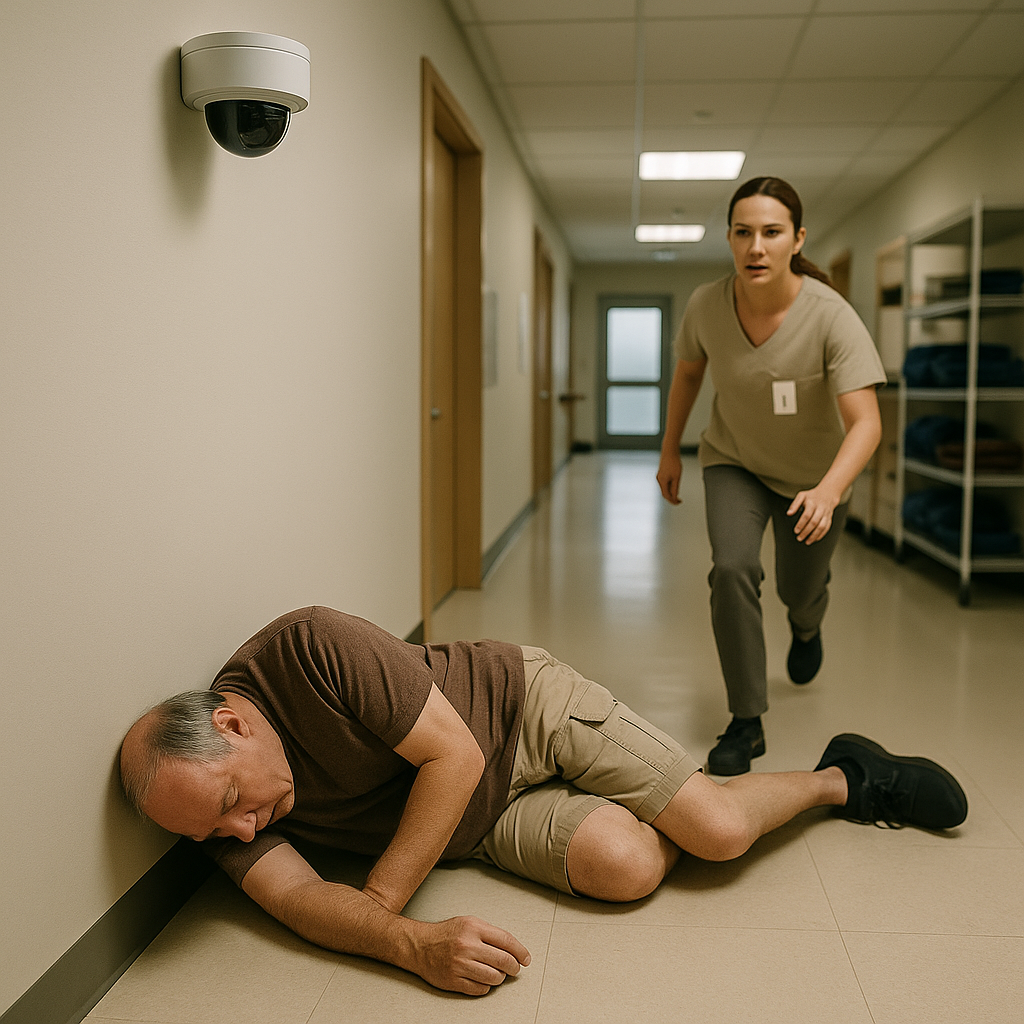
If you’re responsible for safety and security operations, you don’t need more video—you need faster incident alerts and cleaner handoffs. Falls stall patient and guest flow, create risk, and tie up staff. The position here is simple: turn the cameras you already own into real‑time fall signals, route them to the right person, and auto‑document what happened. You’ll reduce time‑to‑care and clear the area sooner without adding headcount.
A practical target many teams set is shaving minutes off the window between a fall and first on‑scene acknowledgement. Even a qualitative gain—moving from “found during rounds” to “alert in seconds”—improves safety expectations and mitigates risk by reducing unattended incidents.
How fall detection works without a rebuild
Nureal’s pre‑trained Computer Vision AI fall detection model runs on existing IP cameras to detect, classify, and track fall events. Agentic AI moves the workflow from detect to action: incident alert goes to assigned staff with location and a short clip; acknowledgment is captured; a basic audit record is created. Generative AI adds a concise natural‑language summary so supervisors see context at a glance.
Example workflow: instant staff push notification + clipped video + location → staff acknowledges in the channel you already use → care dispatched → automated audit trail. This ties operational awareness to measurable outcomes: faster response, fewer unattended incidents, and smoother hallway or aisle flow after triage.
Why pre‑trained models beat long builds
Traditional VMS gives you video after the fact. Cloud CV toolkits ask you to train from scratch. Developer‑first AI can take months before the first meaningful alert. Pre‑trained, use‑case models change the equation: activate fall detection on a selected camera and see signal quality in your environment the same day. That makes time‑to‑value predictable and lets you expand by area, not by a risky all‑or‑nothing deployment.
Operationally, that means you can pilot on one high‑traffic corridor, confirm that incident alerts reduce the gap between event and staff arrival, and then roll to adjacent zones. This approach supports safety compliance expectations and risk mitigation without disrupting your current systems or workflows.
Deployment in hours, not months
The model library retrofits to your existing IP cameras. No identity tracking, no persistent identification—just behavioral signal monitoring. Start with one location that sees regular guest or patient movement. Activate the fall detection model. Validate alerts and tune notification routing with your team in real conditions. Many teams report a clear qualitative metric after the first shift: “alerts arrive while the person is still on the ground,” which shortens time‑to‑care and clears the area faster for throughput.
For public buyers who need a procurement path, Nureal is available on Sourcewell Contract #041525‑NURL. That keeps acquisition straightforward while you focus on incident response and reporting.
From alert to audit without extra paperwork
Agentic AI structures the flow: detect → classify → correlate → notify → audit. Generative AI produces a short incident summary that can be copied into your report. The impact shows up in daily operations: fewer missed falls, cleaner documentation that supports internal audits, and reduced dwell time in corridors and aisles after an event. This is not a clinical device; it’s operational tooling that helps you meet safety expectations and mitigate liability.
Talk to an expert. Start with one camera. Activate one model. See it work in your environment.
How pre‑trained models speed deployments and agentic workflows overview.
Sources
https://nvidia.github.io/ai-workbench/guide/concepts/models.html https://arxiv.org/abs/2308.00352