
City sensor rollouts should not become hardware reflexes
Transportation planners and traffic engineers are being asked to prove that redesigns reduce risk before capital dollars move. NYC’s planned expansion to 100 AI street sensor locations, reported by Fox News, shows how much demand exists for pedestrian and vehicle analytics that can guide safer road design.
The lesson should not be that every city needs another sensor procurement. The better lesson is that city leaders need defensible, privacy-aware evidence from the streets they already monitor. Most municipalities already own camera fleets at intersections, transit corridors, campuses, civic buildings, and public works sites. The faster path is to turn those feeds into operational awareness before buying new hardware.
Existing cameras can produce the signals planners need
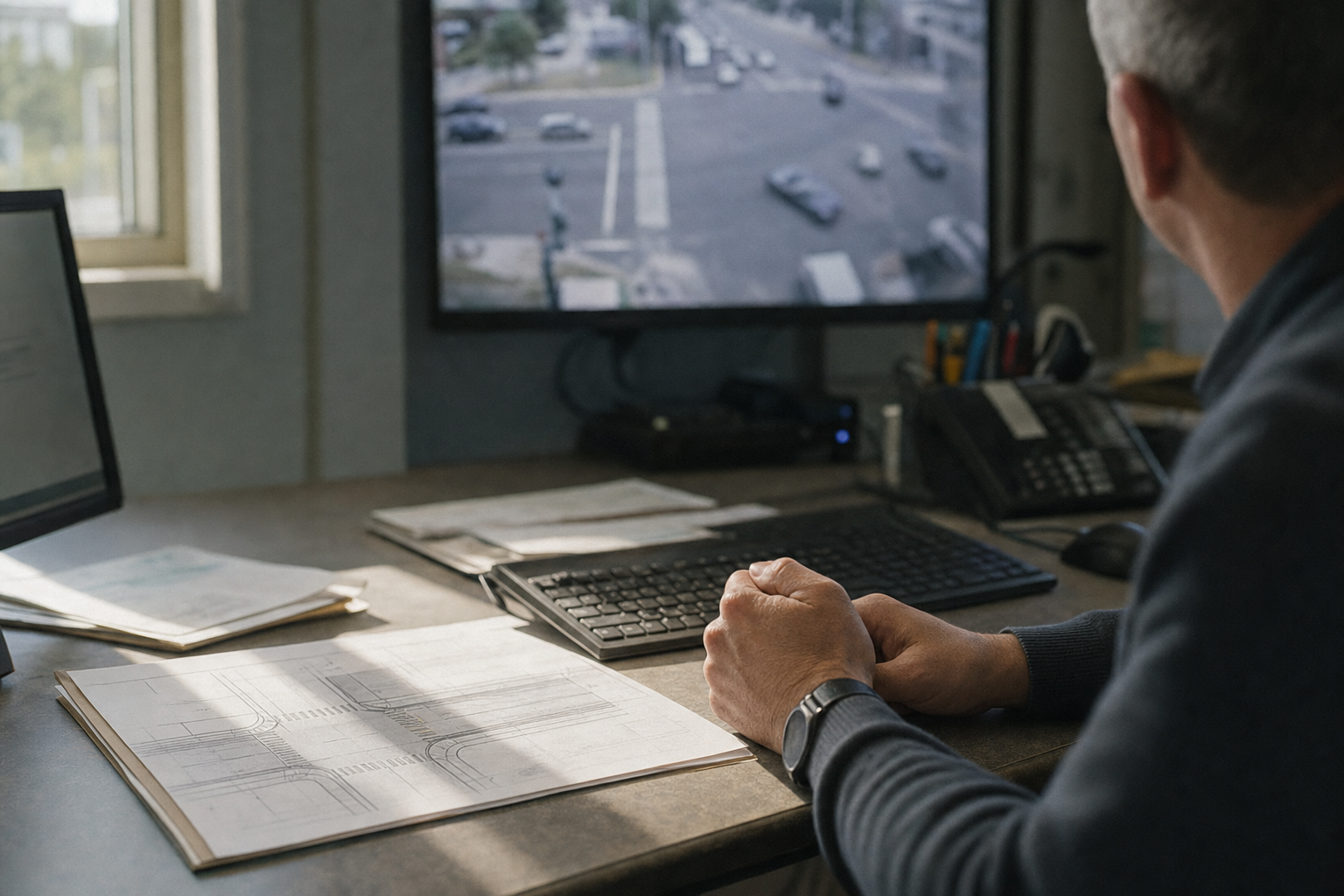
A traffic study often depends on temporary counters, manual observation, consultant fieldwork, or delayed crash reports. Those inputs matter, but they can be slow when a corridor needs action now. Computer Vision AI can retrofit onto existing cameras and measure pedestrian counts, vehicle movement, crossing delays, lane violations, and near-miss behaviors.
For a Vision Zero team, the practical value is not a prettier video feed. It is a pattern of behavior: where pedestrians wait too long, where turning vehicles conflict with crosswalks, where vehicles drift into bus lanes, and where heavy pedestrian activity appears outside the expected crossing zone. Those signals help planners prioritize corridors with observed risk rather than the loudest complaint or the most recent crash.
Faster evidence changes the planning cycle
Cities do not need months of new hardware deployment to start learning. With nureal, a team can start with one camera. Activate one model. A downtown intersection camera, for example, could begin collecting pedestrian and vehicle interaction data in days or weeks, not months, using infrastructure the city already owns.
Consider a high-turn-volume crossing near a transit stop. Before a redesign, Computer Vision AI can count pedestrian volume, flag repeated close interactions between turning vehicles and people in the crosswalk, and show when crossing delay rises during peak periods. After signal timing changes or curb adjustments, the same camera can compare the pattern of behavior before and after the intervention. That gives engineers evidence to defend the next capital project.
Agentic AI turns signals into operational work
Raw detections are not enough. Planning teams need reports, alerts, and action items that fit existing workflows. Agentic AI can convert Computer Vision AI signals into weekly corridor summaries, exception reports, and prioritized recommendations for review by transportation staff.
That matters because the audience for road design evidence extends beyond engineers. Public works directors, elected officials, procurement officers, and community stakeholders need clear explanations of why one intersection moves ahead of another. A ranked list based on pedestrian-vehicle interactions, lane violations, and crossing delay gives city staff a stronger basis for budget decisions than anecdote alone. It also reduces the time planners spend turning field observations into presentations.
Monitoring must respect governance and privacy
The right approach is monitoring, not surveillance. For street design, cities need pattern-of-behavior signals, not continuous identification or long-term raw video retention. A privacy-aware program should focus on counts, movement, interactions, and risk indicators that help reduce collision risk without making identity the point of the system.
This is also why retrofitting matters. Traditional deployments often make analytics feel tied to new poles, new boxes, or camera replacement cycles. nureal’s Computer Vision AI works with the cameras you already own and is ready to deploy on day one, which helps transportation teams test value before expanding. For procurement teams evaluating contract paths, nureal is available on Sourcewell Contract #041525-NURL.
Talk to an expert about which camera, corridor, and model should be your first test.
Sources
https://www.foxnews.com/tech/smart-street-sensors-could-watching-city-next/